

By Lorraine Sharaf
October belongs to pumpkins—in fields and farm stands, on front porches, carved into jack-o’-lanterns and, eventually, baked into pies. But the familiar pumpkin has a history stretching back thousands of years, through Ice Age mammals, Indigenous agriculture, European settlement and some formidable natural defenses.
For our October interview, BCFA went directly to an authority on the subject: Muggle, the heaviest pumpkin ever recorded. Grown in England by twin brothers Ian and Stuart Paton, Muggle weighed 2,819 pounds and measured more than 21 feet around when officially weighed and measured on October 6, 2025.
Linus, we may have found your Great Pumpkin.
BCFA: Welcome, Muggle. Where were you grown, and how long did it take you to become a 2,819-pound pumpkin?
 Muggle: I was grown in Lymington, Hampshire, England, by Ian and Stuart Paton, twin brothers who have been growing giant pumpkins for more than 50 years. I grew for 131 days to achieve this greatness.
You are quite a specimen. Are all pumpkins basically the same plant? And where do the other squashes and gourds fit in?
Pumpkin is a common name for certain members of the genus Cucurbita. We belong to the Cucurbitaceae, or gourd family, along with other squashes, gourds, cucumbers, melons and watermelons.
That’s also where the word cucurbitacin comes from. Cucurbitacins are intensely bitter compounds produced by members of the Cucurbitaceae family as a defense against being eaten.
Cucurbitacins sound unpleasant.
They can be. The wild ancestors of modern squash were small, hard and extremely bitter, with high concentrations of cucurbitacins in their flesh and rind.
Over thousands of years, people selected pumpkins and squashes with much lower levels of these compounds. But cucurbits can still become unusually bitter, particularly when plants are stressed by drought, extreme temperatures or irregular watering.
There is one rule worth remembering: If a pumpkin, squash, cucumber or other cucurbit tastes unusually bitter, don’t eat it and don’t feed it to animals.
Before we get too far into your history, we need to settle something. Are you a fruit or a vegetable?
Botanically, I’m a fruit. I develop from the ovary of a flower and contain seeds. Look at the bottom of a pumpkin, opposite the stem, and you can even see the scar where it was attached to the flower—a sort of pumpkin belly button.
In the kitchen, I’m usually treated as a vegetable. Botanically fruit, culinarily vegetable. I’m versatile.
So what makes something a fruit rather than a vegetable?
Botanical fruits develop from flowers and contain seeds. What we call vegetables in the kitchen generally come from other plant parts—stems such as celery and asparagus, leaves such as spinach, roots such as carrots and radishes, tubers such as potatoes, and bulbs such as onions and garlic.
Where did the pumpkin family begin?
In the Americas. Squashes were among the earliest plants domesticated here, beginning roughly 10,000 years ago in Mexico. Some of the oldest archaeological evidence comes from Guilá Naquitz Cave, a prehistoric rock shelter in the Valley of Oaxaca in southern Mexico, now part of a UNESCO World Heritage Site.
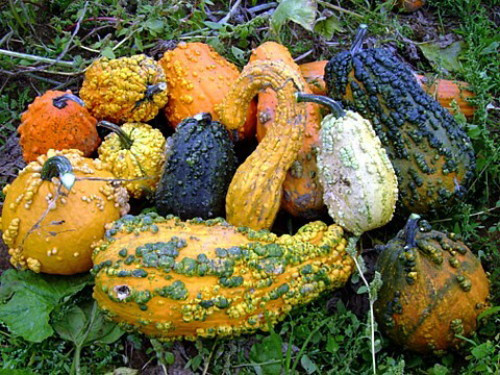 At first, people may have valued wild gourds more for their nutritious seeds and durable rinds than for their bitter flesh. Their hard shells could also serve as vessels and containers.
But if those early fruits were so bitter that most mammals avoided them, how were their seeds dispersed? Did they just rot?
Now the story gets interesting.
During the Pleistocene Ice Age, the Americas were home to enormous herbivores, including woolly mammoths, mastodons and giant ground sloths. These megaherbivores could eat wild gourds that humans and smaller mammals generally avoided. They crushed the tough rinds, ate the fruits and carried the seeds across the landscape in their digestive systems, eventually depositing both seeds and fertilizer in their dung.
When many of those enormous mammals disappeared near the end of the Ice Age, wild cucurbits lost important seed dispersers.
Humans eventually took over—but instead of merely spreading squash, they transformed them.
Transforming them how?
Generation after generation, Indigenous peoples saved seeds from plants with traits they valued—less bitterness, larger seeds, softer rinds, more edible flesh and larger fruits. Over thousands of years, that selective cultivation produced an extraordinary range of squashes.
Long before Europeans arrived, Indigenous peoples throughout the Americas were growing, eating and storing squash. In fact, squash was domesticated before corn, making it one of the earliest cultivated food plants in the Americas.
Is that where the Three Sisters come in?
 Yes, although the sisters didn’t all arrive at the same time. Squash had already been cultivated for thousands of years before corn and beans joined it. Eventually, among a number of Indigenous cultures, the three crops were grown together in the mutually beneficial system known as the Three Sisters.
The plants occupy different spaces and complement one another. Corn grows upright and can support climbing beans. Beans can fix atmospheric nitrogen through their relationship with soil bacteria. Squash travels across the ground, where its broad leaves shade the soil, conserve moisture and suppress weeds.
We squash contribute nutritionally, too. Pumpkin flesh provides fiber, potassium and vitamin C and is rich in beta-carotene, which the body converts to vitamin A. Even our seeds provide protein, healthy fats, magnesium and zinc.
About that traveling across the ground. Why do pumpkin plants insist on taking over so much territory?
We are not known for respecting property lines.
Most traditional pumpkins grow on long vines that spread outward in search of light, water and space. Some varieties can even develop additional roots where vine nodes touch moist soil.
Bush varieties exist for gardeners with less room, but sprawling is the ancestral habit.
Do those vines provide habitat for anything besides pumpkins?
 Certainly. A pumpkin patch is an ecosystem, not simply a collection of fruit.
Our broad leaves create shade and cover near the soil. Our flowers provide food for insects, and pumpkin production depends heavily on pollinators.
Pumpkins produce separate male and female flowers on the same plant. Pollen has to move from a male flower to a female flower before a pumpkin can develop, and bees—including native squash bees, bumblebees and honey bees—do much of that work.
Poor pollination can leave a young pumpkin beginning to grow, only to shrivel and die.
So who eats pumpkins besides humans?
Everyone, it seems. Insects, rodents and other wildlife may eat our flowers, leaves, seeds or fruit. Livestock can eat pumpkins too—a useful fact after Halloween, when millions of pumpkins have finished their decorative careers.
Humans eat nearly every edible part of the plant. The flesh can be roasted, baked, steamed, puréed or simmered. The seeds can be roasted. Even pumpkin blossoms are edible.
When did pumpkins get to Europe?
Only after Europeans reached the Americas. Explorers carried squash seeds across the Atlantic beginning in the late 15th and early 16th centuries.
Our name traveled too. “Pumpkin” ultimately comes from the Greek pepon, meaning “large melon.” The word passed through French and English forms before early American colonists arrived at “pumpkin.”
European colonists in North America learned from Indigenous peoples how useful pumpkins could be. They stored well and could be roasted, boiled, stewed or added to breads and other dishes.
One early preparation involved hollowing out a pumpkin, filling it with milk, honey, apples and spices, replacing the top and baking the whole thing in hot ashes—a culinary ancestor of pumpkin pie.
Speaking of eating you, which pumpkins make the best recipes?
 Probably not one weighing 2,819 pounds.
Carving pumpkins are selected for qualities such as size, shape, color and relatively thin walls that are easy to cut. Smaller culinary, or “pie,” pumpkins generally have denser, sweeter flesh and a smoother texture.
And don’t overlook the rest of my family. Butternut, kabocha, delicata, acorn and other winter squashes can often be used anywhere you would use pumpkin—and sometimes offer even better flavor and texture.
Roasting is one of the simplest preparations because it concentrates the natural sugars. From there, the flesh can become soup, risotto, ravioli filling, bread, muffins, curry or, of course, pie.
We can’t interview a pumpkin in October without talking about jack-o’-lanterns. How did your family end up having faces carved into you?
You can thank—or blame—a much older tradition.
Long before pumpkins became Halloween decorations, people in Ireland and elsewhere in the British Isles hollowed vegetables such as turnips, carved faces into them and placed candles inside. The lanterns became associated with Halloween folklore and were used to frighten away evil spirits around All Hallows’ Eve, when the boundary between the living and the dead was believed to be especially thin.
When Irish and Scottish immigrants came to North America in the 19th century, they encountered pumpkins—a native American crop that was considerably larger and far easier to hollow and carve than a turnip.
The pumpkin won.
If someone particularly likes the pumpkin they grow this year, can they save its seeds and grow the same thing next year?
Perhaps. But don’t count on an exact copy.
Open-pollinated pumpkins and squashes can cross with compatible varieties of the same species. Bees may carry pollen between plants. That won’t change the pumpkin you harvest this year—the surprise appears in the next generation, when you plant its seeds.
To keep a variety true to type, seed savers need to know the species they’re growing and either isolate it from compatible varieties or control pollination by hand.
If you’re willing to experiment, though, saved squash seed can produce something you never expected.
Where can Bucks County residents find pumpkins grown close to home?
You are asking someone raised in Hampshire.
Point taken. We’ll handle this one.
 Bucks County has an abundance of farms and farm markets where residents can find locally grown pumpkins, gourds and other fall crops. Local options include AGA Farms LLC in Perkasie, Hellerick’s Adventure Farm in Doylestown, None Such Farm in Buckingham, Manoff Market Gardens in New Hope, Penn Vermont Fruit Farm in Ottsville, Solebury Orchards in New Hope, Solly Brother’s Farm in Warminster, and Styer Orchard in Langhorne. Check with individual farms for current pumpkin availability, picking opportunities and hours.
Buying a pumpkin locally also supports the people who grew it—not merely the pumpkin.
BCFA: One last question. Halloween is over. The candle has burned out, the neighbors have taken down the cobwebs, and there is a pumpkin sitting on the porch. What should happen to it?
Muggle: Almost anything is better than automatically throwing it away.
 If a pumpkin is still sound, hasn’t been carved and is an edible variety, eat it.
Save the seeds for roasting—or, when appropriate, for planting.
Some local farms can use clean pumpkins and gourds as feed or enrichment for livestock. BCFA can help point readers toward appropriate local options. Don’t leave pumpkins at a farm without permission, and first remove candles, wax, paint, glitter, toothpicks or other decorations.
Plain pumpkin can also be prepared for dogs. Cook or roast the flesh without butter, sugar, salt or spices and serve an appropriate amount plain or mixed with their regular food. Pumpkin pie filling and seasoned pumpkin dishes are not substitutes for plain pumpkin.
Pumpkins can also be composted, returning their nutrients and organic matter to the soil.
One caution: if a cucurbit is extremely bitter, moldy, rotten, painted or otherwise contaminated, don’t use it as food for people or animals.
BCFA: So after roughly 10,000 years of pumpkin-human history, your advice is not to end up in a plastic trash bag?
Muggle: A trash bag is the last place that anyone or anything should end up. We curcubits are way too valuable for that end!


0 Comments