

It truly feels like summer now that tomato season has arrived! There are so many varieties, colors, and flavors that we just had to learn more. BCFA volunteer Charla Bendas and Administrator Jade Greene sat down in the tomato high tunnel for a conversation with one of summer’s biggest stars.

Photo of our interviewee, a Cherokee Purple tomato
BCFA: Thanks so much for taking the time to chat with us today!
Tomato: Of course, I am very busy plumping up and growing but I can make time for you!
What kind of tomato are you? You look beautiful with your deep red and purple coloring. I’m entranced by your shape!
Ha! Thank you. I take great pride in my shape and beautiful colors. I’m a Cherokee Purple, an heirloom tomato. My seeds have been passed down through generations, and my story traces back to Cherokee gardeners who carefully preserved and shared my variety.
Wow! Your history goes way back! Where do tomatoes originally come from?
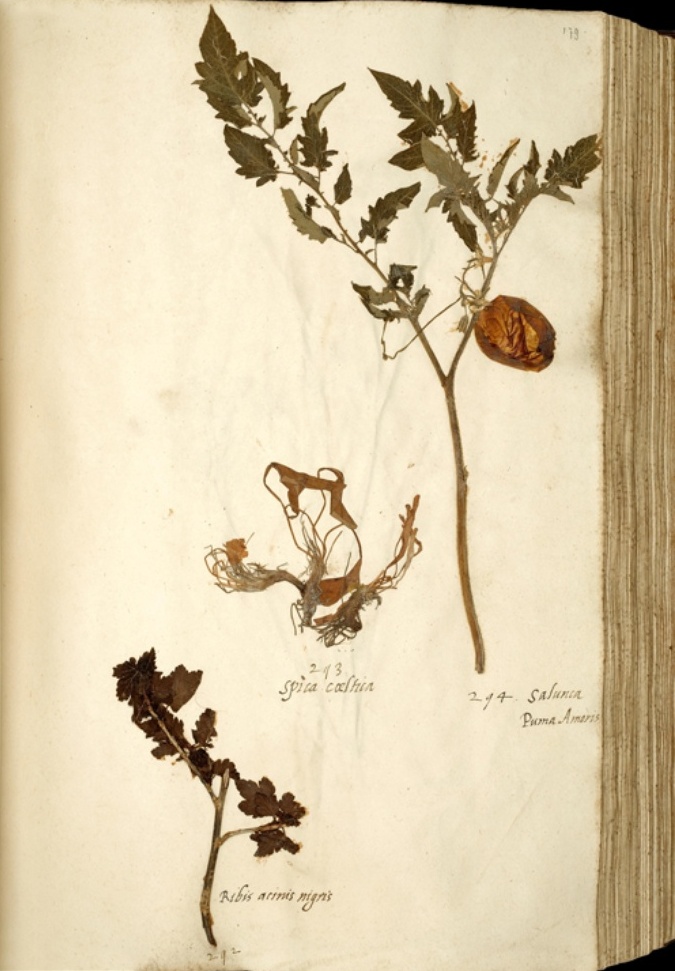
Solanum lycopersicum var. lycopersicum: one of the oldest surviving tomato specimens. Page from the En Tibi Herbarium, 1558. Naturalis Leiden. Wikipedia
Our wild ancestors grew in the Andes Mountains of South America. Like peppers, potatoes, and eggplants, we’re members of the nightshade family and originated there. Different from deadly nightshade (belladonna) and tobacco, edible members of the nightshade family offer good health benefits providing antioxidant and anti-inflammatory nutrients and vitamins A, E, K and folate. Just make sure to avoid eating our leaves, stems, and roots, which contain solanine, a poisonous neurotoxin.
Ok, where was I? Oh yes, Indigenous peoples throughout Central and South America cultivated us long before Europeans arrived. The Aztecs called us “tomatl.”
In the 1500s, Spanish explorers brought tomatoes back to Europe. At first people weren’t sure whether we were safe to eat, but eventually countries like Italy embraced us and the rest is delicious history!
We were later reintroduced and widely cultivated throughout North America. Today there are more than 10,000 varieties around the world. We come in every shape, size, color, and flavor imaginable, making us incredibly versatile in the kitchen. Cherry tomatoes are perfect for salads, beefsteaks make incredible sandwiches, and plum varieties like San Marzano and Amish Paste are ideal for sauces and canning.
Makes sense why we are one of the most popular fruits in the world!
FRUIT?! You taste like a vegetable, how are you a fruit?

Tomatoes develop from the ovary of a flower and have seeds inside so they are FRUIT!
Ah the age old question. Ok yes, we taste like a vegetable because we are pretty savory and have a low sugar content, who needs sugar anyway? But botanically speaking, we are fruit since we are produced from the ovary of a flower and contain seeds inside our fruit.
Here’s another fun fact: there’s actually no botanical definition of a “vegetable.” It’s a culinary term. In fact, the famous Supreme Court case Nix v. Hedden (1893) ruled that tomatoes should be considered vegetables for taxation because that’s how people commonly use them in cooking. Legally, I’m a vegetable. Botanically, I’m a fruit. I prefer the science term.
Got it. Fruit, vegetable…tomayto, tomahto! Since you’re technically a fruit, tell me about your life as a flower.
I’m a bit of a trickster! My flowers have something called poricidal anthers, which means they only release pollen through tiny pores instead of opening wide. That makes pollination a little more challenging.
Luckily, some bees have evolved an amazing technique called buzz pollination, or sonication. A bee grabs onto my flower and rapidly vibrates its flight muscles. Those vibrations shake the pollen loose like salt from a shaker, allowing the bee to collect it.
Wow so honey bees must be your most important pollinator?

Bumblebees are a main pollinator of tomatoes as they are capable of “buzz pollination”
Surprisingly, no! Honey bees don’t buzz pollinate, plus we also don’t produce much nectar, so they usually aren’t very interested in visiting us anyway. Our biggest fans are native bees like bumble bees, mason bees, and other native solitary bees. The good news is we’re also capable of self-pollination, especially when the wind or a gentle shake helps move our pollen.
Ok so this is a great reason to plant native plants! They will attract more of these native pollinators and pollinate your flowers! Do you benefit from any other companion planting?
Absolutely! I love growing next to my best friends: basil, marigolds, and bush beans. Basil and marigolds can help deter certain pests, while beans improve soil by adding nitrogen. Just don’t plant me too close to potatoes since we share many of the same diseases and pests. Brassicas, like cabbage and broccoli, hog all the nutrients and water.
Good to know. Good to know! So when conditions are right, just how productive can a tomato plant be?

Have you seen a tomato garden in August? We don’t know how to slow down! Once the season hits, you’ll be making salsa, salads, sauces, soups, and figuring out how to preserve us for winter.
The largest tomato ever grown weighed more than 10 pounds—about the size of a bowling ball. Under ideal greenhouse conditions, tomato vines can stretch more than 30 feet. And one especially ambitious cherry tomato plant produced over 32,000 tomatoes!
That’s mindblowing! Have any favorite recipes?
Oh, that’s impossible to answer! Fresh salsa, tomato soup, BLTs, pizza, pasta sauce, caprese salad…I feel like Bubba from Forrest Gump listing shrimp recipes.

If you’re looking to preserve summer’s bounty, try making tomato jam or even tomato leather. You can also freeze whole tomatoes or preserve homemade sauce through canning or freezing.
Thank you so much, this was fun!
My pleasure! Now go visit your local farmers market and enjoy tomato season while it lasts!
Find dozens of heirloom and hybrid tomato varieties this week at the Doylestown and Wrightstown Farmers Markets. Ask your farmer which is their favorite variety. Know your farmer, know your food!


0 Comments